I’ve had bonding on a chipped lower incisor multiple times, but the filling lasts less than a week before coming off. What can my dentist do to keep the repair in place? – Thanks. Seth from IN
Seth,
A chipped lower front tooth can be surprisingly difficult to restore successfully. Patients are often discouraged when a dental bonding or another restoration comes off, but the underlying issue is frequently related to the bite rather than the restorative material.
Why Is Your Bite So Important When Repairing a Chipped Lower Incisor?
Your bite determines how much force the repaired tooth must absorb. Every time the teeth come together, the lower incisors contact the backs of the upper front teeth. If a chipped edge is rebuilt with composite, the restoration needs protection from excessive biting pressure. Otherwise, repeated stress can weaken the bond over time.
A tooth that sticks out slightly farther than the others can receive much more force.
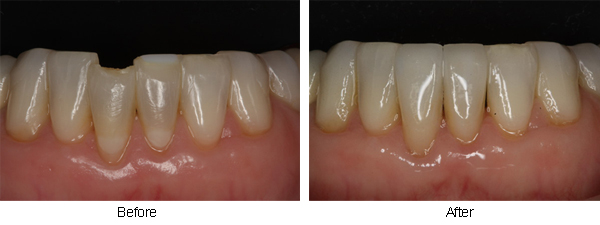
In the example, tooth #24 retained its composite repair, while tooth #25 lost its bonding. Tooth #25 projects slightly farther forward, making it more likely to contact the upper teeth first. That concentrated force can place the restoration at greater risk of failure.
What Is the Treatment for a Chipped Lower Incisor?
Successful treatment focuses on both the restoration and the patient’s bite. Replacing the missing tooth structure is insufficient. Long-term success depends on creating a balanced bite that spreads chewing forces across all the front teeth.
Treatment may include:
- Adjusting the shape or position of the affected tooth.
- Making sure the lower front teeth contact the upper teeth evenly.
- Selecting an appropriate restorative material.
- Carefully evaluating the bite after the repair is complete.
In this case, Dr. Bell restored both lower incisors with porcelain veneers and reshaped tooth #25 so it no longer extended farther forward than #24. The result distributed biting forces more evenly and produced a stable restoration. Similar success may also be possible with composite bonding when completed by a dentist experienced in cosmetic dentistry and occlusion.
Photos courtesy of Dr. Ian Bell of Bellevue, WA
What If Advanced Cosmetic Treatment Is Not Available Locally?
If access to highly experienced cosmetic dentists is limited, smoothing the rough edges of the chipped tooth may be the most practical option. Although it does not replace the missing tooth structure, it can reduce irritation to the lip and improve comfort while other treatment options are considered.
This post is sponsored by Lowell cosmetic dentist Dr. Michael Szarek.