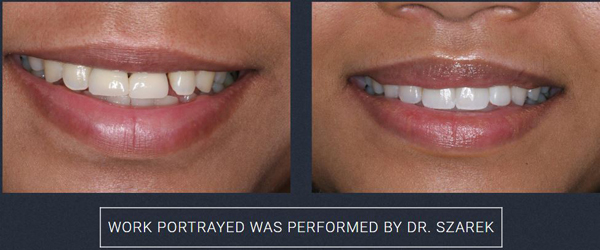
In 2022, when I had my current crown installed, my dentist convinced me to add a veneer to the adjacent tooth. The crown tooth had been made wider to close a gap when the original crown was placed, and I was told the veneer would create a more uniform smile. I was hesitant but agreed based on that promise.
Unfortunately, the result wasn’t what I expected. The root canal tooth under my crown is dark gray. When the dentist replaced the old metal-backed crown with an all-ceramic one, light passed through the crown, so the darkness of the tooth made the crown look gray. Now I have three different tooth shades. The crowned tooth looks gray, the veneer doesn’t match the crown, and neither matches my natural teeth.
I’m very disappointed and want to redo everything. My dentist says the underlying tooth is simply too dark and that nothing more can be done. She placed something inside the crown to mask the darkness, but it made little difference.
I can’t believe that, with today’s materials, there isn’t a crown capable of hiding even a very dark tooth. Is my case unusual? I appreciate your suggestions. Thanks. Mireya from FL
Mireya,
Zirconia offers exceptional strength for crowns, but it isn’t the most natural-looking ceramic. To achieve a lifelike result, the ceramist typically layers porcelain over the zirconia. In your case, the bigger concern is masking the dark underlying tooth. That requires careful collaboration between the dentist and the ceramist.
The dentist must communicate the final shade goal and provide an accurate photo of the underlying tooth. Some teams apply the opaquer directly to the tooth before sending the case to the lab. Others ask the ceramist to handle all the opaquing within the crown. Either approach can work when the team has experience managing dark preps.
How Do a Dentist and a Ceramist Affect the Outcome?
Cases like yours depend heavily on the skill and communication of the dentist and the master ceramist. True master ceramists are rare, so excellent cosmetic dentists seek out the best partners—even if that means working with a lab in another state. Lifelike restorations require teamwork, experience, and a shared vision.
What Are the Challenges With Opaquing?
Creating a natural-looking crown over a dark tooth is a delicate process. Too much opaquer can create a flat, chalky appearance. To avoid that result, the ceramist must build depth and translucency.
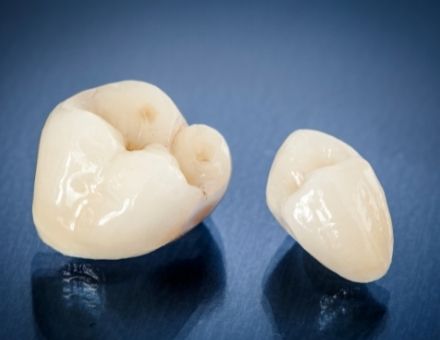
Dental Crown
Before reviewing the key steps, it is helpful to know that natural enamel has a layered color, not a single shade. These principles guide the process:
- Place opaquer deeper in the crown or on the tooth so the ceramist can layer translucent porcelain over it
- Use the full thickness of the crown to build natural warmth and light transmission
An Alternative for the Adjacent Tooth
Your dentist deserves credit for recommending a porcelain veneer rather than a full crown on the neighboring tooth. Veneers are more conservative. However, matching a veneer to a crown is technically demanding and requires a dentist–ceramist team with exceptional color-matching skills.